The materials form a system
A list of tools is only a starting point. Japanese water-based woodblock printing depends on relationships: paper must accept moisture, a block must carry a controlled film of color, and rubbing must bring the two into useful contact. Changing one part can change the behavior of the others. A pale printed area might result from less pigment, a different brushing action, reduced pressure or later fading. Its appearance alone cannot settle the cause.
The term mokuhanga literally refers to woodblock printing and is often used today for Japanese-style water-based practice. Historical materials and contemporary workshop choices vary. A modern teaching demonstration may use convenient substitutes that explain the process well without reproducing the exact materials of an Edo-period commercial workshop. Keep demonstration, historical description and object identification separate.
Wood and the cut edge
Cherry wood is associated with the fine carving required for many traditional commercial prints. A close, durable working surface supports delicate lines and repeated use. Yet Japanese woodblock printing has never depended on a single species in every context. Contemporary artists may choose plywood or other woods for availability, scale, grain or a desired mark. A visible woodgrain effect is a feature to describe, not a species identification.
Relief printing uses the surface left standing after carving. A knife defines edges; other tools clear larger areas. The result depends on the relationship between the raised design and the cleared recesses. The carver must protect thin lines while opening enough surrounding space to keep unwanted areas from printing. Tool sharpness matters for control and safety, but an online description is not a substitute for supervised instruction in cutting technique.
Paper is an active material
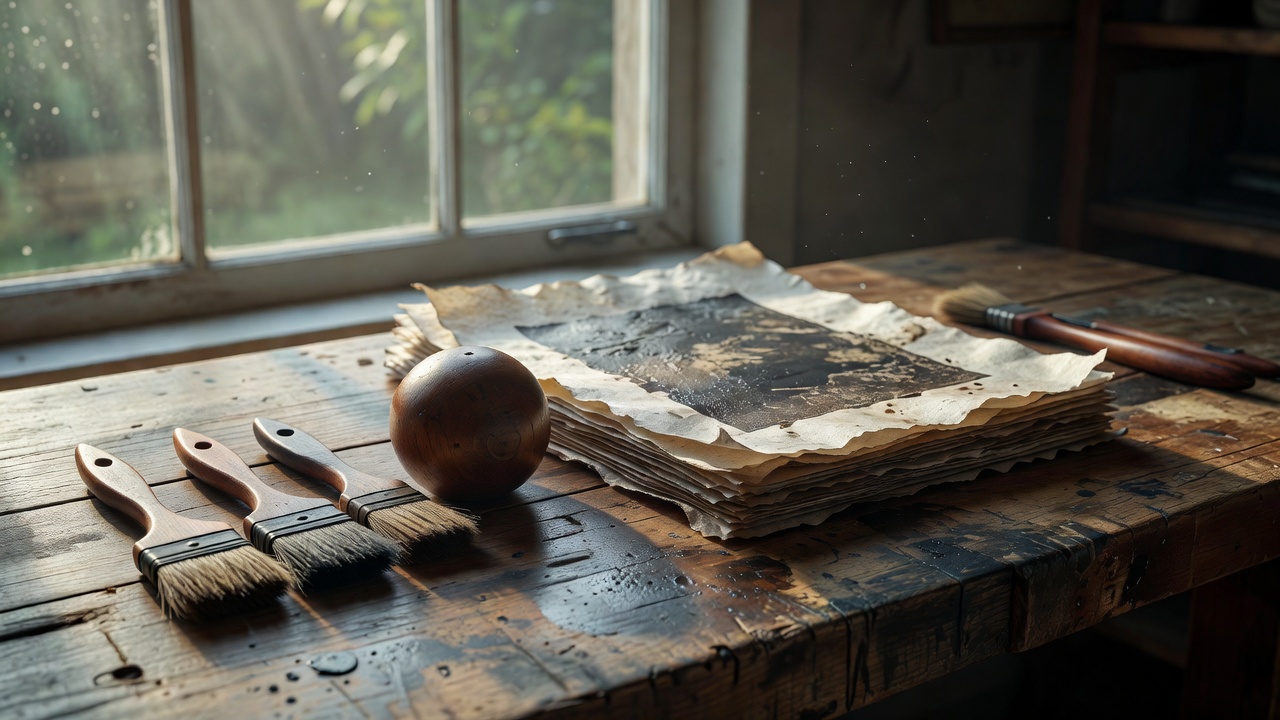
Washi is a broad term for Japanese paper, not a promise of one fiber, thickness or manufacturing method. Kōzo, mitsumata and gampi are important papermaking fibers with different characteristics. Papers used for printing may also contain mixtures or other fibers. Hōsho names a paper category with a significant history, rather than every sheet suitable for a woodblock impression.
Sizing can help control how water and color enter the sheet. Traditional dōsa sizing commonly involves animal glue and alum, although recipes and applications differ. The paper’s moisture level then influences flexibility, absorption and registration. Too much or too little moisture can complicate printing, but there is no universal moisture setting that applies to every paper and workshop climate. Printers learn a material’s behavior through controlled trials.
For a viewer, fiber and surface can be difficult to judge from a screen. Backlighting, magnification and direct examination may reveal information unavailable in a catalogue thumbnail, but fragile objects require appropriate handling. Do not wet a historical sheet, rub it, apply solvents or attempt to expose fibers to identify it. Questions about treatment belong with a qualified paper conservator.
Color, paste and the brush
Traditional water-based printing uses color with water and often a rice-starch paste. The paste helps manage distribution and the behavior of the printing mixture. Brushes move that mixture across the raised wood. Loading, direction and the condition of the brush can affect the impression. A printer can build density with repeated operations or create a transition by controlling the color at an edge.
Historical colorants changed over time. Imported Prussian blue became important in nineteenth-century Japanese printmaking, while other mineral, organic and later synthetic materials also contributed to palettes. A color name in a catalogue is not always a laboratory identification. Digital photography, display settings and fading make visual identification especially uncertain. Material claims should rest on documented research or appropriate analysis, not on the apparent brightness of a reproduction.
Pressure and surface effects
The baren is a rubbing tool used against the back of the sheet. Traditional examples use a coiled inner structure beneath a bamboo-sheath covering, though contemporary alternatives exist. Its action transfers color through controlled contact. The printer varies force and movement rather than simply pressing as hard as possible. The distinction matters when interpreting uneven density: pressure is one possible explanation among several.
| Term | Basic action | Looking prompt |
|---|---|---|
| Bokashi | Controlled color gradation during printing | Where does tone fade, and how consistently? |
| Karazuri | Uninked relief impression creates embossing | Does angled light reveal a raised pattern? |
| Goma-zuri | Printing creates a granular, “sesame” texture | Is the texture localized and repeated elsewhere? |
| Solid color passage | Even application and transfer of color | Are density and edges consistent across the area? |
These terms describe techniques, not grades of quality. An effect may be deliberate, economical, experimental or specific to a commission. A reproduction can also conceal it. Keep the language proportionate: “a textured passage is visible” is a better first note than confidently naming a technique from a small image.
Sources and next steps
- Adachi Institute: materials and traditional production
- Mokuhankan: contemporary collaborative printmaking
- The Metropolitan Museum of Art: technique and historical context
Continue with careful looking and attribution to turn material observations into a clear, limited record.